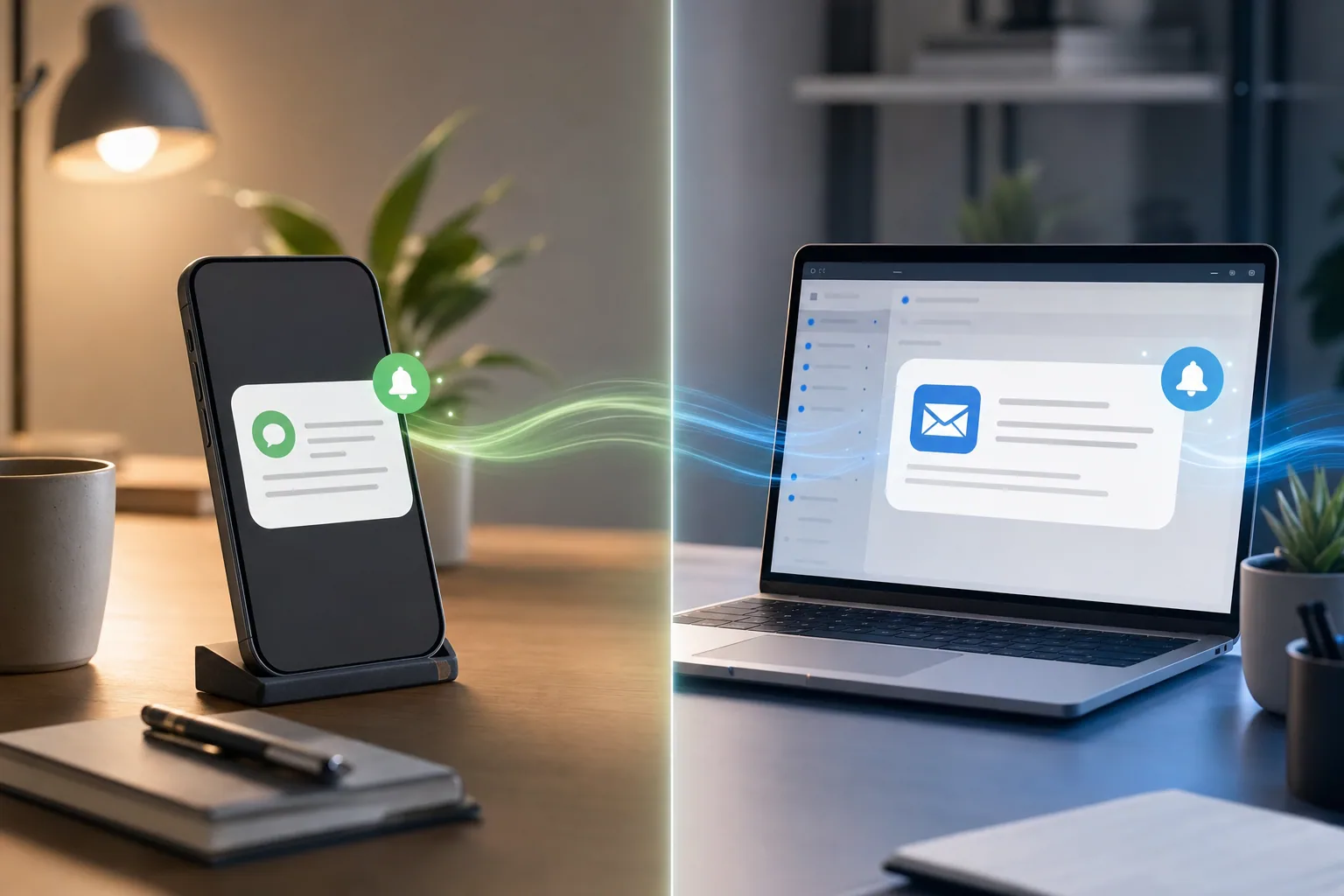
When deciding how to reach your customers, you face a critical choice: SMS marketing for business or traditional email campaigns. Both channels offer real advantages, but they work differently. Understanding the strengths and limitations of each helps you pick the right tool, or better yet, use them together.
SMS Marketing for Business: Speed and Immediacy
SMS has a stark advantage in one area: attention. Text messages are read within minutes. Studies consistently show that SMS open rates hover around 90 to 98 percent, compared to email open rates of 15 to 25 percent. When you need a message delivered fast, SMS wins.
SMS also travels less distance between sender and receiver. There's no spam folder, no algorithm deciding whether your message appears. A text lands directly on someone's phone. This directness makes SMS ideal for time-sensitive promotions, appointment reminders, and urgent customer service.
The trade-off is space. You have roughly 160 characters per message. That's about two sentences. You can't tell a story or build context the way you can in an email. SMS works best for single, clear actions: "Your appointment is tomorrow at 2pm. Confirm or reschedule here."
Another consideration is cost. SMS typically charges per message. Higher volumes mean higher expenses. Email, once your list is built, scales nearly free.
Email Marketing: Depth and Storytelling
Email lets you write. You can explain benefits, share stories, include images, and guide readers through logic step by step. Longer-form content lives in email. So does relationship-building.
With email, you're not limited to 160 characters. A well-crafted email can contain multiple sections, links, calls to action, and visual hierarchy. You can segment your list by behavior and send highly targeted campaigns based on what each subscriber has done or expressed interest in.
Email also preserves a formal record. Subscribers can reference your message later. They can forward it, save it, or return to it when they're ready to act. This matters for announcements, educational content, and detailed offers.
The downside is attention. Your message competes with hundreds of others in an inbox. Open rates are lower. Users might mark you as spam or unsubscribe. Getting past email filters requires technical knowledge and reputation management.
SMS Marketing vs Email Marketing: A Comparison
| Factor | SMS | |
|---|---|---|
| Open Rate | 90-98% | 15-25% |
| Read Time | Minutes | Hours or days |
| Message Length | 160 characters | Unlimited |
| Cost Per Message | Higher per unit | Lower at scale |
| Best For | Time-sensitive, urgent | Detailed, relationship-building |
| Compliance | TCPA rules, opt-in required | CAN-SPAM, opt-in required |
| Visual Options | Limited | Rich formatting, images |
When to Use SMS Marketing
Pick SMS when urgency matters. Order confirmations, shipping updates, appointment reminders, flash sales with tight deadlines, and customer support responses all benefit from SMS's speed and high open rate.
Use SMS for businesses where immediacy drives conversions. A restaurant texting a customer who abandoned a reservation. A fitness studio confirming class enrollment. A service provider sending a tech support link when a customer calls.
SMS also excels in two-way conversations. AI-powered voice and SMS agents can handle customer inquiries and bookings around the clock, turning every message into a potential conversation rather than a one-way announcement.
When to Use Email Marketing
Email shines when you have something to explain. Product launches, educational series, case studies, newsletters, and nurture sequences all live in email. If your message needs context or visual richness, email is the channel.
Email works when you want to build a relationship. Regular newsletters keep your brand top-of-mind. Educational content positions you as a trusted advisor. Email also lets you test different subject lines and track which approaches drive opens and clicks over time.
Use email when your audience is not in a rush. A prospect early in the buying journey may not want a text. They may appreciate a detailed email they can read when convenient.
Combining SMS and Email for Maximum Impact
The strongest strategy often combines both. Email handles storytelling, nurturing, and building trust. SMS delivers urgency and immediate response. Together, they create multiple touchpoints.
For example, send an email with a detailed product announcement. Follow up with an SMS reminder about a limited-time offer. Or send an email series to warm leads, then use SMS to announce that registration closes in 24 hours.
This approach also suits smart, automated workflows. When a customer signs up, email can deliver a welcome sequence. When they abandon a cart, SMS can prompt an immediate recovery. When they book an appointment, both channels can confirm and remind them.
Synergy Digital Solutions specializes in building these integrated systems. AI automations can trigger the right message on the right channel at the right time. Smart websites connected to your CRM ensure that every interaction, whether email or SMS, feeds into your broader marketing picture. The result is faster conversions and stronger customer engagement.
Measuring Success on Both Channels
Track different metrics for each channel. For SMS, monitor delivery rates, open rates (which are nearly always high), and click-through rates on links. Most importantly, measure conversion: did the SMS actually drive the action you wanted?
For email, pay attention to open rates, click-through rates, and unsubscribe rates. A/B test subject lines and content to improve performance over time. Segment your list and measure which groups respond to which messages.
Both channels should feed into a larger picture of customer behavior. Which messages lead to repeat business? Which channel gets customers to act fastest? Use that insight to refine your mix.
Choosing between SMS marketing for business and email isn't really an either-or decision. The best results come from using both channels strategically. SMS captures urgency and drives immediate action. Email builds trust and delivers substance. When you deploy them together, you reach customers where they are and move them toward your goal faster. Start by identifying which of your key messages are time-sensitive and which require depth, then map each channel accordingly.